Use CasesFirmware developers
Find bugs before they reach production
Metalware tests candidate builds in your CI pipeline automatically, no hardware or test harness required.
Quality at scale
Bridge the gap in embedded testing
You don't have to choose anymore. Metalware delivers the scalability of software testing with the fidelity of hardware testing.
What tests miss
How Metalware compares
| Unit tests | Static analysis (SAST) | Simulation / SIL | Hardware in the loop | Field testing | ||
|---|---|---|---|---|---|---|
| Find bugs without writing tests | No | Yes | No | Yes | No | 1Partly (note 1) |
| Finds reliability defects | No | 2Partly (note 2) | Partly | Yes | Partly | Yes |
| Tests vendor SDK and RTOS code | No | 3Partly (note 3) | 4Partly (note 4) | Yes | Yes | Yes |
| Tests the binary you ship | No | No | Partly | Yes | Yes | Yes |
| Findings confirmed by running them | Yes | No | Yes | Yes | Yes | Yes |
| Reproducible in your debugger | Yes | No | Partly | Yes | Partly | No |
| Root cause pinpointed | Partly | Yes | Partly | Yes | No | No |
| No test code to maintain | No | Yes | No | Yes | No | Partly |
| No hardware needed | Yes | Yes | Yes | Yes | No | No |
| Runs on every CI build | Yes | Yes | Yes | Yes | Partly | No |
| Time to results | Seconds | Minutes | Minutes | Hours | Hours | Weeks |
| Catches electrical and physical faults | No | No | No | No | Partly | Yes |
- 1Note 1: Eventually, from customers, where cost/risk is highest
- 2Note 2: Only some types of failures, typically high false-positive rates
- 3Note 3: Only if the vendor provides source
- 4Note 4: Often stubbed or mocked
Works with your pipeline
Test each build without holding up the pipeline
Step 1: Build
Your release build produces the firmware binary as it does today.
Step 2: Submit
A CI job uploads the binary, and the analysis runs unattended.
Step 3: Review
Your team reviews the findings and fixes what it confirms before the build ships.
Every binary your pipeline produces can get its own analysis, in parallel.
What you get
Everything you need to start a fix
- Root cause
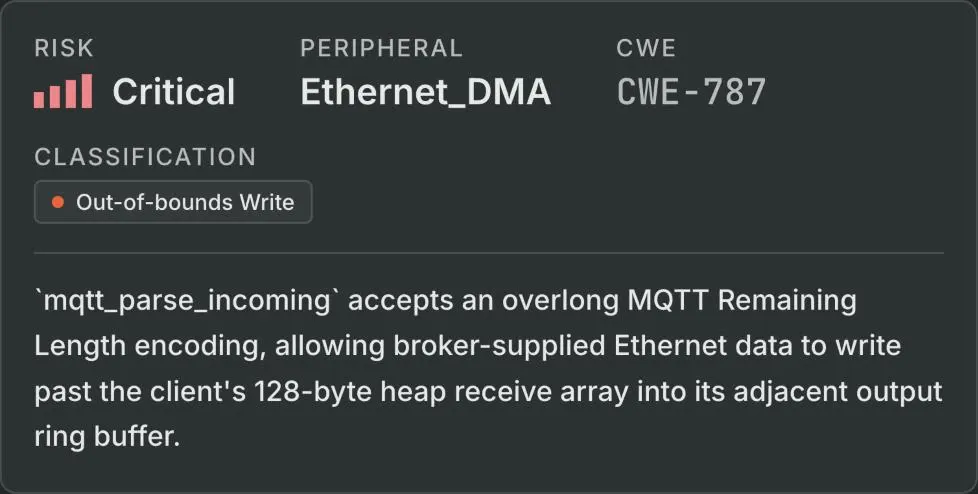
- Each defect explained in the code, with its defect class.
- Triggers
- The input or conditions that caused the defect.
- Reports
- PDF reports to attach to a ticket or send to a supplier.
- Integrations
- Replay POCs in GDB, Ghidra, or Binary Ninja.