Use CasesCompliance / audit
Automatic testing. Automatic evidence.
Metalware ensures every firmware release gets the same in-depth analysis, with evidence to meet your compliance requirements.
Quality at scale
Quality and scale is no longer a trade-off
Regulations rarely specify how deep to test, leaving resource-constrained teams forced to cut test quality to finish on time. Metalware gives every test the same depth, automatically.
Evidence
Automatically generate the artifacts you need
- PDF reports
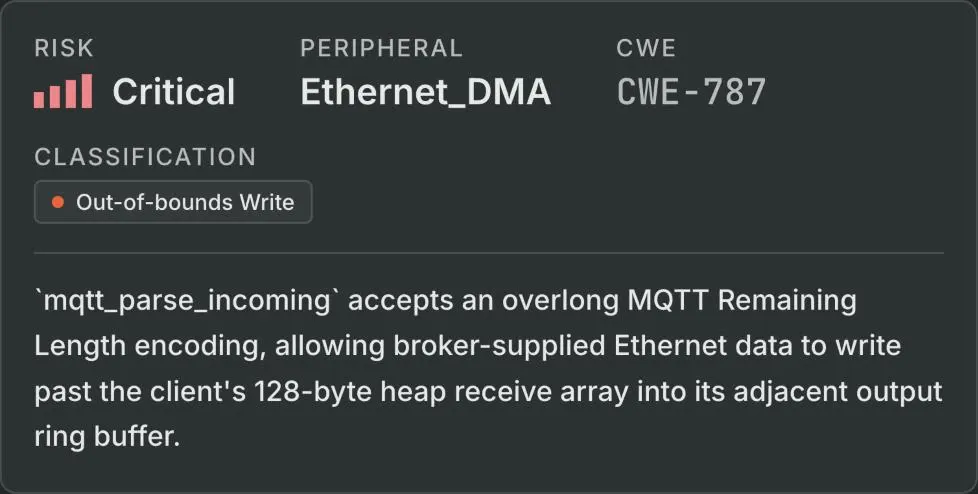
- Individual reports for each defect, with root cause, stack trace and more.
- Coverage
- Figures for each analysis that state how much of the code was exercised or examined.
- Review
- Document your team's assessment of each finding.
- Tool version
- The Metalware version recorded for each run, to describe the tool in a test report.
Requirements by rule
How Metalware supports your requirements
See how Metalware's automated firmware analysis helps meet industry-specific guidance and regulations.
NIST SP 800-53 Rev. 5 (Release 5.2.0) and the Risk Management Framework11 requirements
| Rule and clause | Requirement | How Metalware supports it |
|---|---|---|
| SA-11, developer testing and evaluation | Developers test at a defined depth and coverage and produce evidence of “the results of the testing and evaluation”. The discussion names static, dynamic and binary analysis and fuzzing. | Metalware tests each firmware build from the binary with fuzzing, static analysis and reliability testing. Each analysis records the findings, the coverage and your team's verdicts as evidence of the results. |
| SA-11(1), static code analysis | Developers “employ static code analysis tools to identify common flaws and document the results of the analysis”. | Metalware's static analysis follows input from the peripherals through the compiled code to the flaws that this input can reach. Metalware reproduces each static finding in emulation to reduce noise and false positives. It records your team's verdict on each finding. |
| SA-11(8), dynamic code analysis | Developers “employ dynamic code analysis tools to identify common flaws and document the results of the analysis”. The discussion names fuzz testing and code coverage analysis. | Metalware fuzzes the firmware in an instrumented emulator through its peripheral registers and DMA buffers to find memory corruption, for example out-of-bounds writes. It records the input that causes each defect and reports coverage over time. |
| SA-15(7), automated vulnerability analysis | Developers “perform an automated vulnerability analysis”, determine exploitation potential and mitigations, and “deliver the outputs of the tools and results of the analysis”. | A CI job can send each build to Metalware. Metalware analyzes each build automatically with fuzzing, static analysis and reliability testing, and groups the findings by input interface and potential impact. Your own scripts can use the findings and their evidence through Metalware's API. |
| SI-2, flaw remediation | “Identify, report, and correct system flaws” and “test software and firmware updates related to flaw remediation for effectiveness and potential side effects before installation”. | Metalware analyzes each firmware binary with fuzzing, static analysis and reliability testing and finds flaws in your own code and in vendor code. Before you install an update, Metalware can give the update binary the same analysis. |
| SI-2(7), root cause analysis | “Conduct root cause analysis” to identify the underlying causes of issues or failures, then develop, implement and monitor actions that address them. | Metalware explains the root cause of each defect in the decompiled code. It also gives the input that causes the defect and the call stack. Each reliability finding explains why the code can fail and is rated for likelihood. |
| SI-10 and SI-10(3), input validation and predictable behavior | “Check the validity of the following information inputs” and “verify that the system behaves in a predictable and documented manner when invalid inputs are received”. | Metalware fuzzes each peripheral register and DMA buffer with generated data to find where the firmware handles invalid input incorrectly. Its static analysis follows input to the operation where it causes damage. |
| RA-5, vulnerability monitoring and scanning | “Monitor and scan for vulnerabilities in the system and hosted applications”. For custom software, the discussion names “static analysis, dynamic analysis, binary analysis, or a hybrid of the three approaches”. | Metalware combines binary analysis, fuzzing and static analysis to test your own code and the vendor code in the firmware. It finds defects whether or not anyone has published them as CVEs. |
| CM-7(8), binary or machine executable code | Prohibit binary or machine-executable code “from sources with limited or no warranty or without the provision of source code”, with exceptions only for compelling mission or operational requirements and with the approval of the authorizing official. The discussion covers “commercial software and firmware” and says such products are assessed “for potential security impacts”. | When firmware arrives without source code, Metalware tests it from the binary. It exports the recovered binary as a Ghidra database for review. Its findings and coverage figures give evidence for the exception decision. |
| SR-5(2), assessments before selection, acceptance, modification or update | “Assess the system, system component, or system service prior to selection, acceptance, modification, or update.” The discussion lists static and dynamic analyses and fuzz testing among the methods. | Metalware tests a component's firmware from the binary before selection, acceptance, modification or update. It uses fuzz testing, static analysis and reliability testing and does not need help from the supplier. |
| SP 800-37 Rev. 2, task A-3, and DoDI 8510.01, tasks A-3 and A-4, control assessments | Assessors “may incorporate” prior assessment results “from the system developer or vendor”, and DoD assessment reports include results from developer test events. | Metalware's records for each firmware release are developer test results that an assessor can check. Each defect comes with a POC, and each analysis records its coverage and your team's verdicts. |
US Department of War (DoD) issuances12 requirements
| Rule and clause | Requirement | How Metalware supports it |
|---|---|---|
| DoWI 8430.01, paragraphs 2.8.f and 2.8.g.(2), assurance evidence | Components “produce verifiable assurance evidence, including static and dynamic code analysis, fuzz testing”, among other methods, and automate its generation where possible. | For each firmware build that a CI job sends, Metalware runs fuzz testing, static analysis and reliability testing. Each defect comes with a POC that a reviewer can run to verify the evidence. |
| DoWI 8430.01, paragraph 3.5.f.(8), continuous vulnerability management | Covered software, firmware included, meets requirements for “continuous vulnerability management, including static/dynamic analysis and dependency scanning integrated into pipelines”, validated “through automated tooling where feasible”. | A CI job can send every firmware build to Metalware for automatic fuzzing, static analysis and reliability testing. Each analysis records its findings, its coverage figures and the Metalware version. |
| DoWI 8430.01, paragraph 3.5.f.(3), input validation | Covered software, firmware included, is tested against requirements that address “input validation, output encoding, and injection prevention”. | Metalware fuzzes the DMA buffers and every peripheral input that the firmware reads. Its static analysis follows that input to the location where it causes damage. Each security finding shows the peripheral that supplies its input. |
| DoWI 8430.01, paragraph 3.5.f.(7), operational resilience | Covered software, firmware included, is tested against requirements that address “operational resilience, including runtime protection, fault tolerance, and rollback/recovery mechanisms”. | Metalware's reliability testing finds ignored failure statuses, deadlocks and recovery errors. These defects can make a device hang or prevent its recovery. Each finding explains why the code can fail and is rated for likelihood. |
| DoDI 5000.83, paragraph 3.3.c.(11), automated software vulnerability analysis | Lead systems engineers “incorporate automated software vulnerability analysis tools throughout the lifecycle of the system”, from development and operational test through sustainment. | Metalware runs fuzzing, static analysis and reliability testing automatically on each firmware build or update that a CI job sends. It works from the binary, so you can use it from development through sustainment. |
| DoDI 5000.89, paragraph 3.5.b.(4), cooperative vulnerability identification | Program managers plan cooperative vulnerability identification: “T&E activities to identify vulnerabilities and plan the means to mitigate or resolve them, including system scans, analysis, and architectural reviews”, starting with prototypes. | Metalware analyzes each firmware build, from the first prototype on, with fuzzing, static analysis and reliability testing. Each defect comes with a POC and an explanation of its root cause. |
| DoDI 5200.44, paragraph 1.2.d.(4), and DoDI 5000.89, paragraph 5.2.b.(17), custom and commodity software | TSN risk management will “Assess vulnerabilities in custom and commodity hardware and software through thorough use of test and evaluation capabilities, including developmental, acceptance, and operational testing” (5200.44). DT&E includes T&E activities “to detect cyber vulnerabilities within custom and commodity hardware and software” (5000.89). | Metalware tests the compiled binary, with your own code and any vendor SDK and RTOS code in it. You can use it on development builds and on delivered binaries at acceptance. |
| DoWM 5000.103, paragraph 3.2.a.(3), security verification | Cyber DT&E uses developer and program security verification data, including “software assurance processes” and “code analysis tools and techniques (automated or not)”. The glossary's example is “software assurance processes (e.g., fuzzing)”. | Each analysis gives verification data for one firmware build. This data contains the fuzzing defects with their inputs and root causes, the static and reliability findings, and the coverage figures. |
| DoWM 5000.103, paragraphs 3.2.a.(4) and (8), vulnerabilities and system faults | Cyber DT&E identifies “exploitable cyberspace vulnerabilities and other system faults” and informs program managers of risks to “system availability, recoverability, and overall cyber resilience”. | Metalware's fuzzing and static analysis find security defects that the firmware's inputs can reach. Metalware's reliability testing finds faults that can make a device hang, reset or fail to recover. Each reliability finding explains why the code can fail and is rated for likelihood. |
| DoWM 5000.103, paragraph 4.3.a.(13) and Table 2, software assurance testing | Cyber DT&E plans draw on the test types in Table 2, among them software assurance testing, which “identifies and eliminates software errors and vulnerabilities in critical components”. | Metalware finds software errors and vulnerabilities in compiled firmware with fuzzing, static analysis and reliability testing. It explains the root cause of each defect, so that your team can fix it. |
| DoWM 5000.103, Table 2, non-IP device and component testing | Testing verifies the security and resilience of “embedded systems, real time operating systems, protocols, and platforms”, including interface testing of how incoming data is validated. | Metalware tests microcontroller firmware, bare metal or with an RTOS, from the binary. It fuzzes the incoming data at each peripheral and shows where malformed input causes a fault. |
| DoWM 5000.103, paragraph 4.2.b.(2)(g)–(i), contractor deliverables | Contracts include delivery of “contractor cyber test data and reports”, “security verification data” and “test-based evidence that corrective actions sufficiently remediate or mitigate mission impacting vulnerabilities”. | For each build, Metalware records the findings with their evidence, the coverage figures and the Metalware version. Each fuzzing defect has a PDF report. Each build that contains a fix can get a new analysis. |
NIST SSDF, SP 800-218 Version 1.1, and NIST IR 839710 requirements
| Rule and clause | Requirement | How Metalware supports it |
|---|---|---|
| SP 800-218, task PW.4.4, third-party components | “Verify that acquired commercial, open-source, and all other third-party software components comply with the requirements, as defined by the organization, throughout their life cycles.” Examples include “Review, analyze, and/or test code.” | Metalware runs fuzzing, static analysis and reliability testing on the vendor SDK, radio stack and RTOS code in each binary. It does this again for each release or update, without the source code of these components. |
| SP 800-218, task PW.8.2, testing executable code | “Scope the testing, design the tests, perform the testing, and document the results”, recording and triaging all issues found. Executable code “includes binaries”, and one example is fuzz testing. | A CI job can send each build to Metalware. Metalware fuzzes the compiled firmware through its peripheral inputs and runs static analysis and reliability testing. For each finding, it records the evidence and your team's verdict. It also records the coverage figures of each analysis. |
| SP 800-218, task RV.1.2, finding undetected vulnerabilities | “Review, analyze, and/or test the software’s code to identify or confirm the presence of previously undetected vulnerabilities”, for example with automated analysis and testing of all supported releases. | Metalware automatically runs fuzzing, static analysis and reliability testing on each release binary. It can find defects that nobody has reported. Each defect comes with a POC that causes the same fault each time. |
| SP 800-218, task RV.2.1, analyzing each vulnerability | “Analyze each vulnerability to gather sufficient information about risk to plan its remediation or other risk response.” | For each security finding, Metalware records the defect class, the input interface and the call stack. It groups findings by potential impact and gives each reliability finding a likelihood rating. Metalware also records your team's verdict on each finding. |
| SP 800-218, task RV.3.1, root causes | “Analyze identified vulnerabilities to determine their root causes.” One example: “Record the root cause of discovered issues.” | Metalware combines crashes that have the same root cause into one defect and explains that root cause in the decompiled code. Each static finding shows the operation where input causes damage. Each reliability finding explains why the code can fail. |
| SP 800-218, task RV.3.3, similar vulnerabilities | “Review the software for similar vulnerabilities to eradicate a class of vulnerabilities, and proactively fix them rather than waiting for external reports.” | Metalware examines your code and the third-party code in the firmware for each defect class that it covers, for example out-of-bounds writes (CWE-787). It can find instances that nobody has reported. |
| IR 8397, section 2.2, automated testing | “We recommend automated verification to” run tests consistently and check results, among other aims. Automated verification “can be repeated often, for instance, upon every commit or before an issue is retired.” | A CI job can send every build to Metalware. Metalware then runs fuzzing, static analysis and reliability testing automatically. Each analysis records its findings and its coverage figures. |
| IR 8397, section 2.3, static analysis | “We recommend using a static analysis tool to check code for many kinds of vulnerabilities”, with a scanner that detects race conditions for multi-threaded software. Section 3.6: such tools “examine the code, either source or binary”. | Metalware's static analysis examines the compiled binary and follows input from the peripherals to the defects that this input can reach. Metalware reproduces each static finding in emulation to reduce noise and false positives. Its reliability testing finds race conditions and deadlocks. |
| IR 8397, section 2.9, fuzzing | “We recommend using a fuzzer”, which “performs automatic active testing; fuzzers create huge numbers of inputs during testing.” | In an emulator, Metalware runs coverage-guided fuzzing on the compiled firmware through its peripheral registers, DMA buffers and interrupts. For each defect, Metalware gives the input that causes the defect, the call stack and the root cause. |
| IR 8397, section 2.11, included software components | “Use the verification techniques recommended in this section to gain assurance that included code is at least as secure as code developed locally.” | Metalware uses fuzzing, static analysis and reliability testing on your own code. It uses the same techniques on the vendor SDK, radio stack and RTOS code in the binary, without their source code. |
NASA NPR 7150.2D and NASA-STD-8739.8B, software engineering and assurance4 requirements
| Rule and clause | Requirement | How Metalware supports it |
|---|---|---|
| NPR 7150.2D, 4.4.4 [SWE-135], static analysis | The project uses static analysis tools “to analyze the code during the development and testing phases to, at a minimum, detect defects, software security, code coverage, and software complexity”. | Metalware's static analysis finds security defects in the compiled code. Metalware reproduces each static finding in emulation to reduce noise and false positives. Its reliability testing finds defects that can make a device hang, reset or corrupt its state, and each of these is rated for likelihood. Each analysis also reports its code coverage. |
| NPR 7150.2D, 3.11.5 [SWE-159], testing cybersecurity mitigations | The project manager “shall test the software and record test results for the required software cybersecurity mitigation implementations”. A note recommends automated security static analysis. | Metalware fuzzes every peripheral input and runs static analysis on the firmware, which includes the code that implements its cybersecurity mitigations. Metalware reproduces each static finding in emulation to reduce noise and false positives. Each finding records the peripheral that supplies its input and the call stack. |
| NPR 7150.2D, 4.5.14 [SWE-211], off-the-shelf and reused components | The project manager “shall test embedded COTS, GOTS, MOTS, OSS, or reused software components to the same level required to accept a custom developed software component for its intended use”. | Metalware uses fuzzing, static analysis and reliability testing on your own code. It uses the same techniques on the vendor SDK and RTOS code in the firmware binary, without source code from the supplier. |
| NASA-STD-8739.8B, Table 1, SWE-063 task 2, security scan of each release | For each release, software assurance must “confirm that the software has been scanned for security defects and coding standard compliance and confirm the results”. | Metalware runs fuzzing, static analysis and reliability testing on each release binary. It records the findings, the coverage figures and the Metalware version. Software assurance can use these records to confirm the scan and its results. |
Airworthiness security: EASA CS-25 and AMC 20-42, ED-203A/DO-356A, FAA special conditions7 requirements
| Rule and clause | Requirement | How Metalware supports it |
|---|---|---|
| EASA CS 25.1319(a), with CS 27.1319(a) and CS 29.1319(a), information security protection | Equipment, systems and networks are protected from intentional unauthorised electronic interactions that may adversely affect safety, with the security risks “identified, assessed and mitigated as necessary”. | Metalware fuzzes and statically analyzes the equipment's firmware. It reproduces each security finding in emulation to reduce noise and false positives. Each finding shows the peripheral that supplies its input, as evidence for the security risk assessment. |
| EASA CS-E 50(l), with CS-P 230(g) and CS-APU 90(d), engine control systems | Engine control systems, “including networks, software and data”, are protected from intentional unauthorised electronic interactions, and “the security risks and vulnerabilities must be identified, assessed, and mitigated as necessary”. | Metalware fuzzes and statically analyzes the firmware of the control system, with your own code and any vendor SDK and RTOS code in it. For each security defect, Metalware shows the peripheral that supplies the input and the location where the input causes damage. |
| EASA AMC 20-42, section 4(b), identifiable vulnerabilities | After mitigation, the assessment should show that the systems “have no identifiable vulnerabilities, or those vulnerabilities cannot be exploited to create a hazard or generate a failure” with an unacceptable effect. | Metalware reports each security defect that it finds in the firmware with the peripheral that supplies its input. It explains the root cause of each defect and states how much of the code each analysis exercised or examined. |
| EASA AMC 20-42, section 8(a), security verification | Security verification evaluates how effective the mitigations are through “a combination of analysis, security-oriented robustness testing, inspections, and reviews”. | Metalware tests each firmware release with coverage-guided fuzzing of every peripheral input, static analysis and reliability testing. The tests include the code that implements the mitigations, and each analysis reports its coverage. |
| ED-203A/DO-356A, objective O3.1, refutation analyses | Refutation analyses look for vulnerabilities that are not yet identified. The standard counts fuzzing and static and dynamic code analysis among its refutation activities. | Metalware fuzzes the compiled firmware in an instrumented emulator and runs static analysis on it. It can find security defects that nobody has identified, in your own code and in third-party code. |
| ED-203A/DO-356A, objective O3.3, refutation test results | Refutation testing follows written plans. Its results account for every planned test and every test that was run, and their review gives a reason for each discrepancy and keeps it traceable. | Each analysis records its findings with their evidence, the coverage figures and the Metalware version. It also records your team's verdict and comments on each finding. Each fuzzing defect has a PDF report. |
| FAA special conditions under 14 CFR 21.16 (e.g. No. 25-894-SC, 2026), external access, condition 2 | “The applicant must ensure that electronic system security threats are identified and assessed, and that effective electronic system security protection strategies are implemented”. | Metalware fuzzes and statically analyzes the equipment's firmware. Each security finding shows the peripheral that supplies its input and the call stack. These results help you assess the threats and how well the protection works. |
IEC 62443 and ISASecure8 requirements
| Rule and clause | Requirement | How Metalware supports it |
|---|---|---|
| IEC 62443-4-1:2018, SM-9, security requirements for externally provided components | The developer has a process that finds the security risks of every component it obtains from outside sources and uses in the product, and decides how to handle each risk. | Metalware tests the vendor SDK, RTOS and other third-party code in the binary without their source code. It finds defects there whether or not anyone has published them as CVEs. |
| IEC 62443-4-1:2018, SVV-3, vulnerability testing | Testing looks for security vulnerabilities and describes them. It includes abuse-case testing with malformed or unexpected data, such as fuzzing, on every external interface and protocol that existing tools can test, plus attack surface analysis and dynamic testing of how the product manages runtime resources. | Metalware fuzzes every peripheral input, and its static analysis follows that input through the code. Its reliability testing finds resource leaks and resource exhaustion. For each defect, Metalware gives the input that causes the defect and its root cause. |
| IEC 62443-4-1:2018, DM-2 and DM-3, reviewing and assessing security-related issues | Investigate each reported issue to establish whether it applies, can be verified and which threats trigger it (DM-2), then analyze its impact, severity, affected versions and root cause (DM-3). | Each defect comes with a POC and shows the peripheral that supplies its input. Metalware combines crashes with the same root cause, explains each root cause in the decompiled code and groups findings by potential impact. |
| IEC 62443-4-1:2018, SUM-1, security update qualification | Verify that security updates address the vulnerabilities they target and that no update, supplier patches included, introduces regressions. | Before release, Metalware can analyze each security update binary. The analysis covers your code and the third-party code in that binary. Each update has its own findings and coverage figures. |
| IEC 62443-4-2:2019, CR 3.5, input validation | The component validates the syntax, length and content of any input that is used as process control input, or that arrives through external interfaces, and directly affects its actions. | Metalware fuzzes every peripheral input with malformed and unexpected data and keeps the input that causes each defect. Its static analysis follows input to out-of-bounds writes. Metalware reproduces each static finding in emulation to reduce noise and false positives. |
| IEC 62443-4-1:2018, SVV-1, item c), malformed input and edge-case testing | The tests of security requirements include tests at boundaries and edge conditions, stress tests, and tests with malformed or unexpected data that are not aimed at security as such. They check that the product copes correctly when errors occur or input is invalid. | Metalware fuzzes every peripheral input with malformed and unexpected data. Its reliability testing finds failure statuses that the firmware ignores or changes into success, and errors from which it cannot recover. Each reliability finding explains why the code can fail and is rated for likelihood. |
| IEC 62443-4-2:2019, CR 7.1, denial-of-service protection | The component maintains its essential functions when operating in a degraded mode as the result of a denial-of-service event. | Metalware's fuzzing finds inputs that crash the firmware. Its reliability testing finds unbounded waits, deadlocks, CPU starvation and resource exhaustion that can make a device hang or reset. Each reliability finding explains why the code can fail and is rated for likelihood. |
| ISASecure SDLA-312 v6.4 (SDLA and CSA), SDLA-SVV-3A1 and SDLA-SVV-3A5, fuzz test plan and results | For component certification (CSA), the certifier checks that a fuzz test plan covers every interface that parses incoming data, where a tool exists or can be adapted for it, and that the documented results are complete and show every test passing in the end. For SDLA, it checks that the development process requires the plan and the documented results, and confirms both on a sample project. | Metalware fuzzes the DMA buffers and every peripheral input that the firmware reads. You do not need to write a test harness. Each fuzzing defect has its input, trace, root cause and PDF report. Each analysis reports its coverage figures and records your team's verdict on each finding. A build that contains a fix can get its own analysis. |
NERC CIP-013-2, supply chain risk management for the bulk electric system1 requirement
| Rule and clause | Requirement | How Metalware supports it |
|---|---|---|
| CIP-013-2, Requirement R1, Part 1.1, procurement risk | A process, used in planning procurements, “to identify and assess cyber security risk(s) to the Bulk Electric System from vendor products or services”, including from procuring and installing vendor equipment and software. | Metalware tests a vendor's firmware binary and the third-party code in it with fuzzing, static analysis and reliability testing. It does not need source code or help from the vendor. It groups the findings by potential impact. |
EU Machinery Regulation (EU) 2023/1230, applying from 20 January 20276 requirements
| Rule and clause | Requirement | How Metalware supports it |
|---|---|---|
| Annex III, section 1.1.9, first paragraph, connected devices | Machinery is designed so that “the connection to it of another device”, directly or through a remote device, “does not lead to a hazardous situation”. | Metalware makes a diagram of the devices that the chip connects to. It fuzzes every peripheral input, and its static analysis follows that input through the code. Each security finding shows the peripheral that supplies its input. |
| Annex III, section 1.1.9, third paragraph, software and data | Software and data critical for compliance “shall be identified as such and shall be adequately protected against accidental or intentional corruption”. | Metalware finds input that can corrupt memory or overwrite the installed firmware. Its reliability testing finds errors that corrupt the firmware's state without an attacker. Each reliability finding explains why the code can fail and is rated for likelihood. |
| Annex III, section 1.2.1, point (a), external influences | Control systems “can withstand, where appropriate to the circumstances and the risks, the intended operating stresses and intended and unintended external influences, including reasonably foreseeable malicious attempts from third parties leading to a hazardous situation”. | Metalware fuzzes the control firmware through every peripheral input, and its static analysis follows that input through the code. For each defect, Metalware gives the input that causes the defect and its root cause. |
| Annex III, section 1.2.1, points (b) and (c), faults and logic errors | Neither “a fault in the hardware or the logic of the control system” nor “errors in the control system logic” may lead to hazardous situations. | Metalware's reliability testing finds logic errors that can make the firmware hang, reset or corrupt its state. Deadlocks and missed watchdog deadlines are examples. Each finding explains why the code can fail and is rated for likelihood. |
| Annex III, section 1.2.6, failure of the power supply or network connection | “The interruption, the re-establishment after an interruption or the fluctuation in whatever manner of the power supply or communication network connection” to the machinery “shall not lead to hazardous situations”. | Metalware's reliability testing finds unbounded waits, I/O protocol errors, initialization errors and recovery errors in the firmware. Each finding explains why the code can fail and is rated for likelihood. |
| Annex IV, Part A, point (g), and Part B, point (g), test reports | The technical documentation includes “reports and/or results of the design calculations, tests, inspections and examinations carried out to verify the conformity” of the machinery. | Each analysis records its fuzzing, static and reliability findings, the coverage figures, your team's verdict on each finding and the Metalware version. Each fuzzing defect also has a PDF report. |
EU NIS2 Directive, Directive (EU) 2022/25552 requirements
| Rule and clause | Requirement | How Metalware supports it |
|---|---|---|
| Article 21(2)(d) and 21(3), supply chain security | Entities “take into account the vulnerabilities specific to each direct supplier and service provider and the overall quality of products and cybersecurity practices of their suppliers and service providers”. | Metalware tests a supplier's firmware with fuzzing, static analysis and reliability testing. It does not need source code or help from the supplier. It reports defects in the supplier's code and in the SDK and RTOS code in the binary. |
| Article 21(2)(e), acquisition, development and maintenance | Risk-management measures include “security in network and information systems acquisition, development and maintenance, including vulnerability handling and disclosure”. | Metalware can test supplier firmware before you accept it and each supplier update before you install it. It can also test each build of firmware that you develop. For vulnerability handling and disclosure, each defect comes with a POC and an explanation of its root cause. |
EU Cyber Resilience Act, Regulation (EU) 2024/28479 requirements
| Rule and clause | Requirement | How Metalware supports it |
|---|---|---|
| Annex I, Part I, point 2(a), known exploitable vulnerabilities | Where applicable, based on the risk assessment, products are “made available on the market without known exploitable vulnerabilities”. | Metalware fuzzes and statically analyzes each release binary before it ships. It finds defects whether or not anyone has published them as CVEs. Each security finding shows the peripheral that supplies its input and the call stack, which you can use to assess exploitability. |
| Annex I, Part I, point 2(f), integrity | Where applicable, products “protect the integrity of stored, transmitted or otherwise processed data, personal or other, commands, programs and configuration against any manipulation or modification not authorised by the user”. | Metalware finds input that can write out of bounds, change the control flow or overwrite the installed firmware. Its reliability testing finds code that can corrupt the device's own state. Each reliability finding explains why the code can fail and is rated for likelihood. |
| Annex I, Part I, point 2(h), availability | Where applicable, products “protect the availability of essential and basic functions, also after an incident, including through resilience and mitigation measures against denial-of-service attacks”. | Metalware's fuzzing finds inputs that crash the firmware. Its reliability testing finds deadlocks, resource exhaustion and recovery errors that can make a device hang. Each reliability finding explains why the code can fail and is rated for likelihood. |
| Annex I, Part I, point 2(j), attack surfaces | Where applicable, products are “designed, developed and produced to limit attack surfaces, including external interfaces”. | Metalware identifies the peripherals that supply input to the firmware and makes a diagram of the devices that the chip connects to. Its static analysis follows that input through the code. Metalware groups the findings by input interface. |
| Annex I, Part II, point 2, remediating vulnerabilities | Manufacturers “address and remediate vulnerabilities without delay, including by providing security updates”, in relation to the risks the vulnerabilities pose. | Metalware explains the root cause of each defect in the decompiled code. It records your team's verdict on each finding. Before release, Metalware can give each security update its own analysis. |
| Annex I, Part II, point 3, security testing | Manufacturers “apply effective and regular tests and reviews of the security of the product with digital elements”. | A CI job can send each build or update to Metalware. Metalware then runs fuzzing, static analysis and reliability testing automatically. Each analysis records its findings and its coverage figures. |
| Article 13(5), third-party components | Manufacturers “exercise due diligence when integrating components sourced from third parties”. The Commission's CRA FAQs (section 4.4.2) list fuzz testing and firmware analysis among the security tests this can include. | Metalware tests the vendor SDK, radio stack and RTOS code in the firmware binary with fuzz testing, static analysis and reliability testing. It does not need the source code of these components. |
| Article 13(6), vulnerabilities in integrated components | Manufacturers that identify a vulnerability in an integrated component “report the vulnerability to the person or entity manufacturing or maintaining the component” and remediate it. | Metalware finds defects in the vendor SDK, radio stack and RTOS code in the binary. You can send the POC, trace and root cause of each defect to the maintainer of the component. |
| Article 31 and Annex VII, point 6, technical documentation | The technical documentation includes “reports of the tests carried out to verify the conformity” of the product and is “continuously updated, where appropriate, at least during the support period”. | Each analysis of a release or update binary keeps its own test records. These records contain the findings, the coverage figures, your team's verdict on each finding and the Metalware version. Each fuzzing defect also has a PDF report. |
EU radio equipment: Directive 2014/53/EU, Delegated Regulation (EU) 2022/30 and EN 180314 requirements
| Rule and clause | Requirement | How Metalware supports it |
|---|---|---|
| Directive 2014/53/EU, Article 3(3)(d), applied by Delegated Regulation (EU) 2022/30, harm to the network | Internet-connected radio equipment placed on the market from 1 August 2025 to 10 December 2027 “does not harm the network or its functioning nor misuse network resources, thereby causing an unacceptable degradation of service”. | Metalware fuzzes and statically analyzes how the firmware handles input that arrives from the network and the radio. Its reliability testing finds I/O protocol errors, unbounded waits and recovery errors that can make the device hang or reset. Each reliability finding explains why the code can fail and is rated for likelihood. |
| EN 18031-1 and EN 18031-2:2024, clause 6.10.6, and EN 18031-3:2024, clause 6.8.6, GEC-6 input validation | The equipment validates input received through its external interfaces when that input can affect the assets each part protects. | Metalware fuzzes every peripheral input that the firmware reads, for example data that reaches it from a radio or network interface. Its static analysis follows that input through the code. For each defect, Metalware gives the input that causes the defect and its root cause. |
| EN 18031-1:2024, clause 6.6.1, RLM-1 resilience | The equipment uses resilience mechanisms that mitigate denial-of-service attacks on its network interfaces and return it to a defined state, except on interfaces used only in an isolated local network or sufficiently protected by other devices. | Metalware's fuzzing finds network input that crashes the firmware. Its reliability testing finds hangs, resource exhaustion and recovery errors in the firmware. Each reliability finding explains why the code can fail and is rated for likelihood. |
| Directive 2014/53/EU, Article 21 and Annex V, point (h), test reports | The technical documentation includes, wherever applicable, “test reports”, and it is drawn up before the equipment is placed on the market and “continuously updated”. | Each analysis of a release binary keeps its own test records. These records contain the fuzzing, static and reliability findings, the coverage figures, your team's verdict on each finding and the Metalware version. Each fuzzing defect also has a PDF report. |
ETSI EN 303 645 V3.1.3 and TS 103 701, consumer IoT5 requirements
| Rule and clause | Requirement | How Metalware supports it |
|---|---|---|
| EN 303 645, provisions 5.13-1A and 5.13-1B, input validation | Data input at the application layer via user interfaces (5.13-1A) and network interfaces (5.13-1B) “shall be validated by the device regarding unexpected data input to prevent system manipulations and failures”. | Metalware fuzzes the data that the firmware reads from each peripheral, for example data from a network interface or a user interface. Its static analysis follows that input to the defects that this input can reach. Each security finding shows the peripheral that supplies its input. |
| TS 103 701 V2.1.1, test cases 5.13-1A-2 b) and 5.13-1B-2 a), input validation testing | The test lab assesses whether each documented validation method “prevents the processing of unexpected data input”. “Automated tools can be used to generate unexpected data”, and one example is a fuzzer. | Metalware's coverage-guided fuzzing sends unexpected data to the firmware's peripheral registers and DMA buffers. It reports coverage over time. Each defect comes with a POC and shows the peripheral that supplies its input. |
| EN 303 645, provision 5.2-3, monitoring, identifying and rectifying vulnerabilities | “Manufacturers should continually monitor for, identify and rectify security vulnerabilities within consumer IoT products they sell, produce, have produced and associated services they operate during the defined support period.” | Without the source code, Metalware fuzzes and statically analyzes current and earlier release binaries and the third-party code in them. It finds defects whether or not anyone has published them as CVEs. |
| EN 303 645, provision 5.6-9, and TS 103 701 V2.1.1, test case 5.6-9-1, secure development | “The manufacturer should follow secure development processes for software deployed on the consumer IoT device.” The test lab assesses whether these processes cover “security tooling for the implementation phase”, “security testing” and “handling of third-party software providers”. | A CI job can send each build to Metalware for fuzzing, static analysis and reliability testing. The analysis also covers the code from third-party providers in the binary, for example the vendor SDK and radio stack. |
| EN 303 645, provisions 5.9-1 and 5.9-2, resilience to outages | Resilience to network and power outages “should be built in” (5.9-1), and devices “should remain operating and locally functional in the case of a loss of network access and should recover cleanly” after a power loss (5.9-2). | Metalware's reliability testing finds unbounded waits, initialization errors and recovery errors that can make a device hang or fail to recover. Each finding explains why the code can fail and is rated for likelihood. |
FDA, medical devices11 requirements
| Rule and clause | Requirement | How Metalware supports it |
|---|---|---|
| Premarket cybersecurity guidance (February 2026), section V.C, vulnerability testing | Details and evidence of testing such as “abuse or misuse cases, malformed and unexpected inputs” (robustness and fuzz testing), “attack surface analysis” and “static and dynamic code analysis”. | Metalware fuzzes every peripheral input with malformed and unexpected data, and its static analysis follows that input through the code. Its reliability testing finds hangs, race conditions and resource exhaustion. Metalware groups the findings by input interface. |
| Premarket cybersecurity guidance (February 2026), section V.C, footnote 47, testing tools | For testing tools, details that “may include … the name of the tool, version information as applicable, and any settings or configuration options for the tools used”. | Metalware records its version for each analysis run. A test report can then name the tool and the version for each finding and coverage figure. |
| Premarket cybersecurity guidance (February 2026), section V.C, assessment of findings | “For all testing, manufacturers should provide their assessment of any findings including rationales for not implementing or deferring any findings to future releases.” | Metalware records your team's verdict and comments on each finding next to its evidence. Each assessment and its rationale stay on record. |
| Premarket cybersecurity guidance (February 2026), section V.C, testing through the life cycle | Cybersecurity testing “should occur throughout the SPDF” and, after release, “should be performed at regular intervals commensurate with the risk (e.g., annually)”. | A CI job can send every build to Metalware, so each development build, release and update gets its own analysis. Analyses run automatically and in parallel. You can analyze released binaries again on any schedule. |
| Premarket cybersecurity guidance (February 2026), section V.A.4, third-party software components | “All software, including those developed by the device manufacturer … or obtained from third parties, should be assessed for cybersecurity risk.” | Metalware tests the RTOS, vendor SDK and radio stack code in the firmware binary with the same analysis as your own code. It finds defects in these components whether or not anyone has published them as CVEs. |
| Premarket cybersecurity guidance (February 2026), section V.A.5, unresolved anomalies | The assessment of anomalies “may include an assessment for the potential security impacts of anomalies” and “should also include consideration of any present Common Weakness Enumeration (CWE) categories”. | Metalware gives each fuzzing defect a class, the closest CWE and a root cause. It gives each reliability finding a class and a likelihood rating. It groups findings by potential impact and records your team's verdict on each. |
| Premarket cybersecurity guidance (February 2026), sections V.A.6 and VII.C.1, fielded versions | “FDA recommends that vulnerabilities be assessed for any differing impacts for all fielded versions to ensure patient risks are being accurately assessed.” | Metalware works from the binary and runs analyses in parallel. The shipped binary of each fielded version can get its own fuzzing, static analysis and reliability testing. |
| Premarket cybersecurity guidance (February 2026), Appendix 1, code, data and execution integrity | Review all code that parses external data “using automated (e.g., static and dynamic analyses) and manual (i.e., code review) methods”, and “validate that all data originating from external sources is well-formed”. | Metalware runs both types of automated analysis on the code that handles external data. Its static analysis follows peripheral input through this code. Its fuzzing sends malformed and unexpected input to this code in emulation. |
| Premarket cybersecurity guidance (February 2026), section V.B.1 and Appendix 1, resiliency and recovery | Devices “should be designed to be resilient to possible cyber incident scenarios … and maintain availability”, such as denial of service, with controls “tested in order to validate that they were effectively implemented”. | Metalware's fuzzing finds inputs that crash the firmware. Its reliability testing finds code that can hang, deadlock, exhaust resources or fail to recover. Each reliability finding explains why the code can fail and is rated for likelihood. |
| FD&C Act §524B(b)(2), cybersecurity processes | Sponsors of cyber devices maintain processes and procedures “to provide a reasonable assurance that the device and related systems are cybersecure”. FDA's guidance includes cybersecurity testing in the documentation that demonstrates this. | Metalware tests each build with fuzzing, static analysis and reliability testing. It keeps the findings, the coverage figures and your team's verdict on each finding as cybersecurity testing documentation. |
| QMSR, 21 CFR 820.10(c), and ISO 13485:2016, subclauses 7.3.6, 7.3.7 and 7.3.9, design verification, validation and changes | 820.10(c) applies ISO 13485 clause 7.3: design verification (7.3.6), validation (7.3.7) and changes (7.3.9). FDA “recommends verification and validation include sufficient testing … on the cybersecurity of the medical device system”. | Metalware runs fuzzing, static analysis and reliability testing on each firmware build, and on each build after a design change. For verification and validation, it keeps the findings, the coverage figures, your team's verdicts and the Metalware version. |
IEC 81001-5-1:2021, health software security (FDA recognized standard)4 requirements
| Rule and clause | Requirement | How Metalware supports it |
|---|---|---|
| Clause 5.2.3, with Interpretation Sheet 1 (2025), security risks of software from others | Clause 5.2.3 covers identifying and managing the security risks of required software. Interpretation Sheet 1 clarifies that the standard's software categories are nested, so 5.2.3 has applied since 2021 to required, supported and maintained software alike. | Metalware tests the software from others that the firmware binary contains, for example a vendor SDK, a radio stack or an RTOS. It finds defects there whether or not anyone has published them as CVEs. |
| Clause 5.7.3, vulnerability testing | Testing that identifies and characterizes potential security vulnerabilities. The clause derives from IEC 62443-4-1 SVV-3, whose methods include malformed-input testing such as fuzz testing. | Metalware fuzzes every peripheral input and runs static analysis and reliability testing. It reproduces each static finding in emulation to reduce noise and false positives. Each fuzzing defect has a class, the closest CWE and a root cause. |
| Clause 6.2.2, security update verification | Verify that each security update addresses the vulnerability it is meant to fix. | Metalware gives each update binary the same fuzzing, static analysis and reliability testing as a release. Through CI, Metalware can also run regression checks on each update. It keeps the findings and the coverage figures for each update. |
| Clauses 9.3 and 9.4, reviewing and analysing vulnerabilities | Investigate reported vulnerabilities to determine whether they apply, can be verified and which threats they relate to, then analyse each one's root cause and impact on safety and effectiveness. | Each defect comes with a POC, the root cause in the decompiled code and the peripheral that supplies its input. Metalware reproduces each static finding in emulation to reduce noise and false positives. |
UL 2900-1 (first edition, 2017) and UL 2900-2-1, FDA recognized standards3 requirements
| Rule and clause | Requirement | How Metalware supports it |
|---|---|---|
| Clause 15, malformed input testing | Fuzz testing of the product's external interfaces and protocols with malformed and unexpected input, watching for crashes and other behavior outside its specification. | Metalware fuzzes the firmware with malformed and unexpected data at the peripheral registers and DMA buffers behind its external interfaces. It reports coverage over time. For each defect, it gives the input that causes the defect and its root cause. |
| Clause 17 and Annex A, software weakness analysis | Analysis of the product's software for the weakness types in the sources the standard lists, such as the CWE Top 25. | Metalware finds weaknesses in the compiled firmware with fuzzing, static analysis and reliability testing. It labels each fuzzing defect with the closest CWE, for example out-of-bounds write (CWE-787) or null-pointer dereference (CWE-476). |
| Clause 19, static binary and bytecode analysis | Static analysis of the product's compiled binaries and libraries with tools that examine the compiled code rather than the source. | Metalware's static analysis examines the compiled firmware, with any vendor SDK and RTOS code in it. It follows peripheral input to the defects that this input can reach. Metalware reproduces each static finding in emulation to reduce noise and false positives. |
EU MDR and IVDR, Regulations (EU) 2017/745 and (EU) 2017/7466 requirements
| Rule and clause | Requirement | How Metalware supports it |
|---|---|---|
| Annex I, section 17.2, software (IVDR: section 16.2) | Software is developed and manufactured “in accordance with the state of the art taking into account the principles of development life cycle, risk management, including information security, verification and validation”. | Metalware runs fuzzing, static analysis and reliability testing on each firmware build, with your own code and any vendor SDK and RTOS code in it. It explains the root cause of each defect. |
| Annex I, section 17.1, repeatability and reliability (IVDR: section 16.1) | Devices with programmable systems or software are “designed to ensure repeatability, reliability and performance in line with their intended use”, with the risks of a single fault condition eliminated or reduced. | Metalware's reliability testing finds code that can make a device hang, reset or corrupt its state. Each finding explains why the code can fail and is rated for likelihood. |
| Annex I, section 14.2(d), software and IT environment (IVDR: section 13.2(d)) | Devices are designed to reduce “the risks associated with the possible negative interaction between software and the IT environment within which it operates and interacts”. | Metalware fuzzes each peripheral input that receives data from connected systems, and its static analysis follows that data through the code. The results show where malformed input makes the firmware fail. |
| Annex I, section 18.8, unauthorised access (MDR only) | Devices are designed and manufactured “to protect, as far as possible, against unauthorised access that could hamper the device from functioning as intended”. | Metalware's fuzzing and static analysis find where crafted input can write out of bounds, take control of the program flow or overwrite the installed firmware. Each defect shows the peripheral that supplies its input. |
| Annex II, sections 4 and 6.1(b), verification and validation records (IVDR: sections 4 and 6.4) | The technical documentation includes “a justification, validation and verification of the solutions adopted” and the results of software verification and validation. MDCG 2019-16 gives “methods and results of security testing” as an example. | Each analysis records its fuzzing, static and reliability findings with their evidence, the coverage figures, your team's verdicts and the Metalware version. Each fuzzing defect also has a PDF report. |
| MDCG 2019-16 rev.1, section 3.7, verification and validation | “The primary means of security verification and validation is testing.” Its methods include fuzz testing, and additional testing can use “tools for secure code analysis”. | Metalware runs coverage-guided fuzz testing on every peripheral input. It also runs static analysis and reliability testing on the compiled code. Metalware reproduces each static finding in emulation to reduce noise and false positives. |
Health Canada, Pre-market Requirements for Medical Device Cybersecurity (2019)3 requirements
| Rule and clause | Requirement | How Metalware supports it |
|---|---|---|
| Section 2.1.3, Table 2, malformed input (fuzz) testing | Among the tests manufacturers “may consider”: “The device is subjected to massive amounts of malformed (invalid or unexpected inputs) to observe if the device will behave in an unorthodox manner or if it will ‘crash’.” | Metalware fuzzes the firmware in emulation for 24 hours by default. It sends generated input to each peripheral register and DMA buffer. It records each defect, for example an out-of-bounds write, with the input that causes it. |
| Section 2.1.3, Table 2, static binary and bytecode analysis | Among the software weakness tests manufacturers “may consider”: “Utilization of tools that will examine compiled code created from source code.” | Metalware's static analysis examines the compiled firmware and follows peripheral input to the defects that this input can reach. Metalware reproduces each static finding in emulation to reduce noise and false positives. |
| Section 2.3.5.2, cybersecurity testing evidence | Applications include “a detailed summary of testing that was conducted to verify and validate the security of the device” (Class III and IV) and, for Class IV, “reports showing evidence of cybersecurity testing”. | For the testing summary, each analysis records its fuzzing, static and reliability findings, the coverage figures and the Metalware version. For Class IV test reports, each fuzzing defect has a PDF report. |
UN R155, UN R156 and ISO/SAE 21434, vehicles11 requirements
| Rule and clause | Requirement | How Metalware supports it |
|---|---|---|
| UN R155, paragraph 7.2.2.2(e), testing processes | The cyber security management system includes “the processes used for testing the cyber security of a vehicle type”. The Interpretation Document lists fuzz testing among the cybersecurity tests to justify. | A CI job can send every firmware build to Metalware for automatic fuzz testing, static analysis and reliability testing. Metalware records your team's verdict on each finding. |
| UN R155, paragraphs 7.2.2.5 and 7.3.2, supplier dependencies and risks | The manufacturer manages “dependencies that may exist with contracted suppliers” and must “identify and manage, for the vehicle type being approved, supplier-related risks”. | Metalware tests a supplier's firmware from the binary, without source code or help from the supplier. You can send each defect to the supplier with its POC and root cause. |
| UN R155, paragraph 7.3.6, testing before type approval | The manufacturer performs, before type approval, “appropriate and sufficient testing to verify the effectiveness of the security measures implemented”. | Metalware fuzzes every peripheral input of a module's firmware. It also runs static analysis and reliability testing on the firmware. It records the findings, the coverage figures, your team's verdict on each finding and the Metalware version. |
| UN R155, Annex 1, paragraph 9.7, test documentation | The information document includes documents “describing what tests have been used to verify the cyber security of the vehicle type and its systems and the outcome of those tests”. | Each analysis records its fuzzing, static and reliability findings, the coverage figures, your team's verdict on each finding and the Metalware version. Each fuzzing defect also has a PDF report. |
| UN R155, Annex 5, threat 28.1 and mitigation M23, software bugs | Software bugs “can be a basis for potential exploitable vulnerabilities”, particularly if software “has not been tested to verify that known bad code/bugs is not present and reduce the risk of unknown bad code/bugs being present”. Mitigation M23, required where relevant under 7.3.4, includes “Cybersecurity testing with adequate coverage”. | Metalware tests each firmware binary with coverage-guided fuzzing, static analysis and reliability testing, and reports the coverage of each analysis. It finds defects whether or not anyone has published them as CVEs. |
| UN R155, Annex 5, threat 24.1 and mitigation M13, denial of service | Threat 24.1 is “Denial of service, for example this may be triggered on the internal network by flooding a CAN bus, or by provoking faults on an ECU via a high rate of messaging”. Mitigation M13: “Measures to detect and recover from a denial of service attack shall be employed”. | Metalware's fuzzing finds input that crashes the firmware, for example data that reaches it from a CAN bus. Its reliability testing finds hangs, resource exhaustion and recovery errors in the module's firmware. Each reliability finding explains why the code can fail and is rated for likelihood. |
| UN R156, paragraph 7.1.3.3, software verification and validation | The manufacturer demonstrates that “the processes used to verify and validate software functionality and code for the software used in the vehicle are appropriate”. The Interpretation Document says the intention is that “only properly tested software updates are sent to the vehicle”. | Before release, a CI job can send every update binary to Metalware. Metalware tests each update with fuzzing, static analysis and reliability testing. The analyses run automatically and in parallel. |
| ISO/SAE 21434:2021, clause 8.5, RQ-08-05, vulnerability analysis | Weaknesses are analysed to identify vulnerabilities, meaning weaknesses that can be exploited as part of an attack path. | Each security finding shows the peripheral that supplies its input and the call stack. Each defect comes with a POC and an explanation of its root cause. Metalware records your team's verdict on each finding. |
| ISO/SAE 21434:2021, clause 10.4.2, RQ-10-09 and RQ-10-10, integration and verification | Integration and verification show that components fulfil the defined cybersecurity specifications, by methods that include static analysis, dynamic analysis and resource usage evaluation. | Metalware runs static analysis on the compiled firmware and reproduces each finding in emulation to reduce noise and false positives. For dynamic analysis, it fuzzes the firmware in emulation. Its reliability testing finds resource leaks and resource exhaustion. |
| ISO/SAE 21434:2021, clause 10.4.2, RQ-10-11, test coverage | When testing is used for verification, test coverage is evaluated with defined metrics to judge whether the testing is sufficient. | Metalware reports block coverage over time for fuzzing and shows the branches where testing is blocked. Each analysis also states how much of the code it exercised or examined. |
| ISO/SAE 21434:2021, clause 10.4.2, RC-10-12, remaining weaknesses | Testing should confirm that unidentified weaknesses and vulnerabilities remaining in the component are minimized; the methods named for it include fuzz testing. | Metalware runs coverage-guided fuzz testing on every peripheral input of the compiled firmware. It also runs static analysis and reliability testing on the firmware. It can find unreported defects in your own code and in the vendor SDK and RTOS code. |
Keep reading
Read next
- Government & defense IndustryDeveloper testing and supplier assessment records for the Risk Management Framework's Assess step.
- Industrial & critical infrastructure IndustryVulnerability testing under IEC 62443-4-1, for your own process and for ISASecure.
- Connected products IndustryTest reports for the technical documentation the EU Cyber Resilience Act requires.
- Regulated industries IndustryTesting records for an FDA premarket submission, and verification records for each vehicle module under UN R155.
- Findings & evidence ProductThe root cause and evidence that come with every finding.