MetalwareSecurity testing
Find vulnerabilities with AI, and trust the results
Metalware doesn't overwhelm security teams with fake vulnerabilities. It provides validated exploitability, reproducible evidence, proof-of-concepts, and actionable results.
AI native
AI built for firmware, empowered with deterministic tools
Metalware uses custom agents designed specifically for firmware analysis, and gives them both guardrails and tools.
Together they push the frontier of automated firmware analysis far beyond a general-purpose AI model.
All security findings are validated against the emulator to avoid hallucinations, noise and false positives.
Dynamic analysis
Intelligent fuzz testing, no setup required
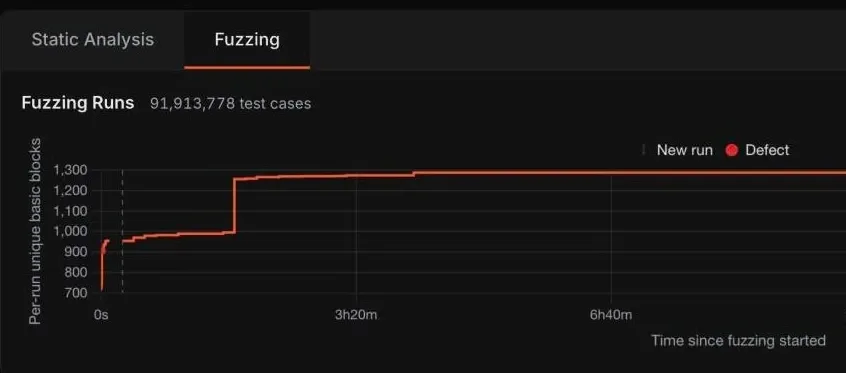
Metalware automatically fuzz tests firmware running in the emulator.
Metalware reproduced Zephyr RTOS CVE-2020-10065 in 42 seconds, without prior knowledge of the CVE.
Static analysis
Static analysis without the noise
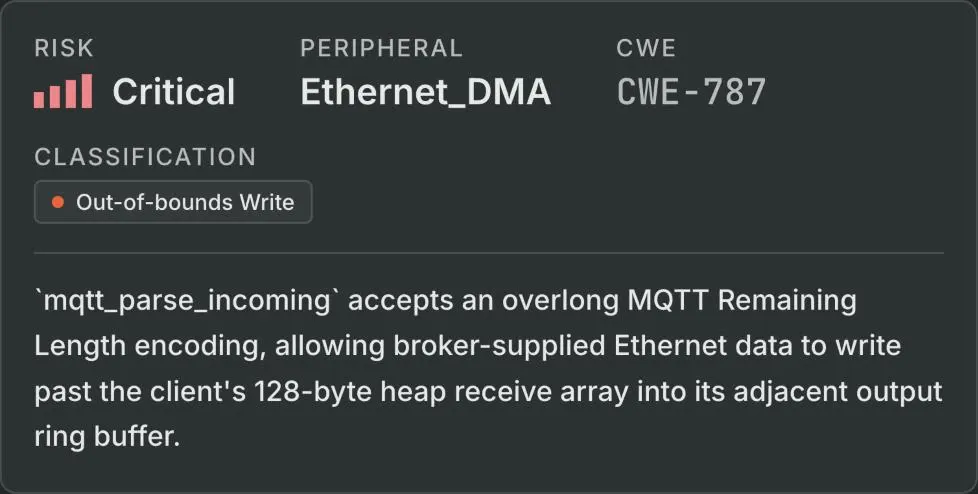
Every static finding is reproduced in emulation, eliminating the noise common with other static scanning approaches.
How it compares
No source code, hardware, or harness required
| Binary firmware scanners (SCA / SBOM) | Source code analyzers | Protocol fuzzers | Manual RE & pen tests | ||
|---|---|---|---|---|---|
| Tests supplier code without source | Yes | Yes | No | 1Partly (note 1) | Yes |
| Finds unknown vulnerabilities | Yes | No | 2Partly (note 2) | Yes | Yes |
| Automated emulation | Yes | No | No | No | No |
| Static analysis | Yes | Yes | Yes | No | Partly |
| Dynamic analysis | Yes | No | No | Yes | Partly |
| SBOM / SCA | No | Yes | No | No | No |
| Tests every attacker input path | Yes | No | 3Partly (note 3) | 4Partly (note 4) | Partly |
| Finds hangs and resource exhaustion | Yes | 5Partly (note 5) | 6Partly (note 6) | Yes | Partly |
| Every finding verified by running it | Yes | No | No | Yes | Yes |
| Root cause in the code | Yes | Partly | Yes | No | No |
| Re-runnable proof of concept | Yes | No | No | Yes | Partly |
| Deduplicated findings | Yes | Partly | Partly | Partly | No |
| Tests every build automatically | Yes | Yes | Yes | Partly | No |
| No hardware or test bench | Yes | Yes | Yes | No | Partly |
| No setup work | Yes | Yes | Partly | Partly | No |
- 1Note 1: Only tests code reachable from the interfaces it tests
- 2Note 2: Typically high false-positive rates and non-exploitable findings
- 3Note 3: Only with manually configured inputs
- 4Note 4: Only interfaces with a test suite
- 5Note 5: Only known CVEs in identified components
- 6Note 6: Only some classes, such as deadlocks and leaks
Keep reading
Questions
What kinds of defects does Metalware find?
Security testing finds out-of-bounds writes and reads, null-pointer dereferences, stack overflows, integer underflows, untrusted control-flow transfers and input that can overwrite installed firmware. Each is mapped to the closest CWE where one applies.
Does Metalware test third-party code in the binary?
Yes. It tests the vendor SDKs, radio stacks and RTOS code compiled into the binary along with your own code, and finds defects there whether or not anyone has published them as CVEs.
Can our team reproduce a finding?
Yes, for fuzzing defects: each comes with a POC that runs in GDB, Ghidra or Binary Ninja, with a full execution trace to step through. Each static finding comes with the call stack from its reproduced path.
Read next
- Findings & evidence ProductThe root cause and evidence that come with every finding.
- Reliability testing ProductHow Metalware finds bugs even if they don't cause a crash.
- Binary analysis and emulation ProductHow Metalware runs a compiled binary without hardware.
- How We're Automating Firmware Fuzzing BlogHow agents and deterministic tools set up the emulator and explain crashes.